First of all, let it be known that the life of Jesus Christ as given in the four Gospels is not what it appears to be on the surface, but rather it refers to something entirely different. It is merely a cover. Furthermore, it seems to have been known for many centuries, but it cannot be determined whether or not this has been known about since the earliest times of Christianity or not. A person of insight could instead have discovered this sometime in the past, not necessarily dating from the origins of Christianity (representing a continuous line of knowledge throughout the generations). Put very simply, there would not have been a Canon of the New Testament without a Historical Jesus Christ – the Divinity had to be invented to fill in the void. The earliest Christian Literature of the First Century just was not enough to produce a Canon of literature.
The Book of Revelation gives the direct correlation of Ezekiel's Vision 1:4-11 with the Vision of Revelation 4:6-9. There is no known documentary evidence for the origin of the Book of Revelation. Irenaeus of Lyons first mentioned the Book of Revelation in his work “Against Heresies” (Book 5, Chapter 30, Section 3), stating the apostle John received the apocalyptic vision “not very long ago, almost in our own day, towards the end of Domitian's reign” – placing it around 95-96 CE. Irenaeus wrote his best-known work “Against Heresies” around 180 CE as a refutation of Gnosticism.
The New Testament canon, the recognized collection of 27 books, developed gradually but was largely solidified by the late Fourth century, with key moments including Athanasius's list in his 39th Festal Letter of 367 CE, the Synod of Hippo in 393 CE, and the Councils of Carthage in 397 & 419 CE, confirming the same books used today, although debates over some peripheral texts continued.
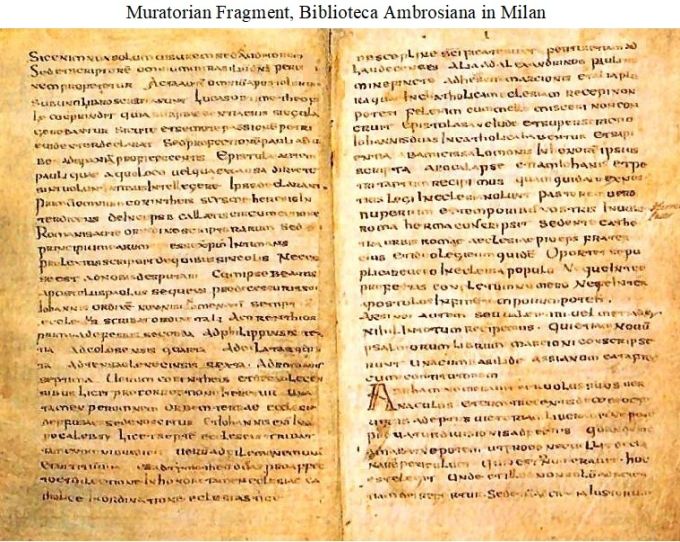
The Muratorian Canon is so-called because it was discovered and published by the Italian historian and scholar Ludovico Antonio Muratori in 1740 from a manuscript he found in Milan's Ambrosian Library, naming this early list of New Testament books after himself (reference numbers Codex J 101 sup, or Codex Amb. I 101 sup).
The beginning of the text is missing, though it provides crucial insight into which books early Christians considered scriptural around 170-200 CE. It's considered to be the oldest known list of New Testament books, recognizing most of the 27 books we know today. It lists the following: Matthew, Mark, Luke, John, Acts of the Apostles, I and II Corinthians, Ephesians, Phillipians, Colossians, Galatians, Romans, I and II Thessalonians, Revelation, Philemon, Titus, I and II Timothy, Jude, I and II John, one Epistle of Peter. The Wisdom of Solomon and Shepherd of Hermas is included only for private reading.
Internal evidence (referencing a recent Shepherd of Hermas while Bishop Pius of Rome was alive), suggests the original text was composed around 180-200 CE. The Muratorian Fragment was found within an 8th-century manuscript codex that originally belonged to the Bobbio Abbey in northern Italy before being moved to Milan in the 17th century. Pieces of the Muratorian Fragment were also found in 11th and 12th-century manuscripts at the Benedictine abbey of Monte Cassino.
This does not represent a 100% consensus view. For example, “The Muratorian Fragment as Roman Fake” by Clare K. Rothschild (Brill, 2018); arguing that the Muratorian Fragment represents an attempt to provide a venerable second-century precedent for a later position on canon.
Sources:
The Muratorian Fragment
The 39th Festal Letter by Athanasius of Alexandria (367 CE)
* See also David Brakke, “A New Fragment of Athanasius's Thirty-Ninth Festal Letter: Heresy, Apocrypha, and the Canon” (Harvard Theological Review 103:1, pages 47-66, 2020)