Last Updated 3 October 2016
Priory of Sion: The Coume Sourde “Stone”
1962 – 2016
Paul Smith
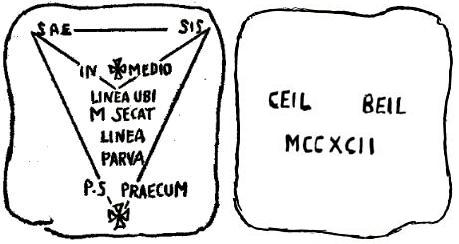
In the possession of Philippe Marlin, of what looks like a prototype-version of the Coume-Sourde “Stone” bearing the handwriting of Philippe de Chérisey, shown for the first time on the Internet circa 2007. Exact date of the piece of paper is unknown
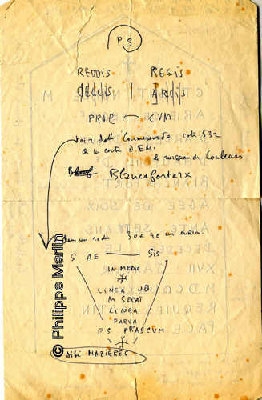 © Archive Philippe Marlin
1962
The existence of the Coume Sourde “Stone” referred to for the first time on a Frances-Inter Radio Programme in July 1962, presented by Robert Arnaut and Robert Charroux, interviewing Noël Corbu who referred to “SAE” and “SIS” in relation to the “Stone”, mentioning “SAE” stood for Sub Altarum Iglesias (‘under the master altar of the church’)
1963
Robert Charroux, article in Plaisir de France (number 298, 1963)
1962-1972
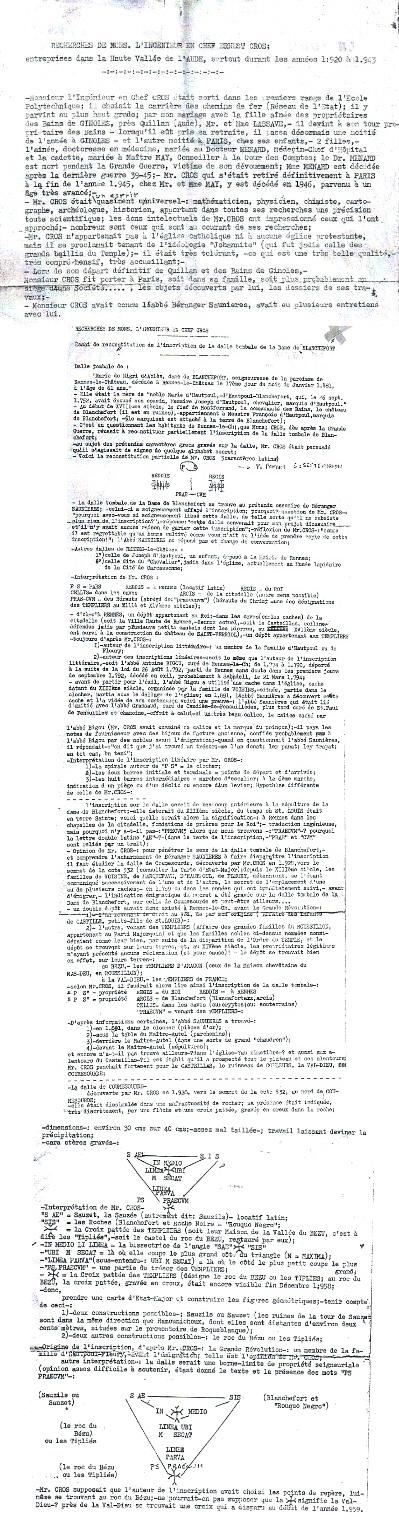
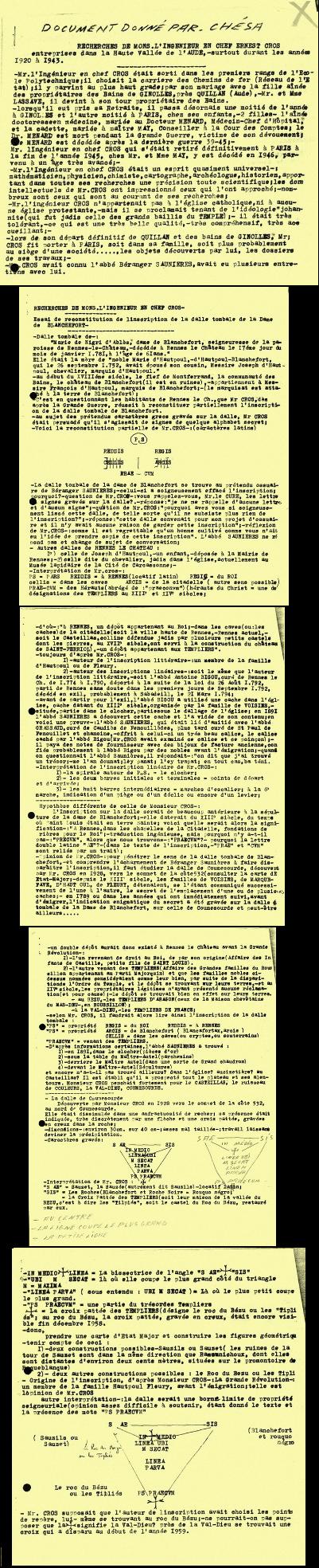
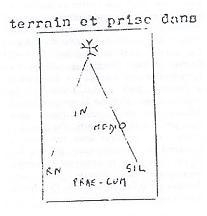
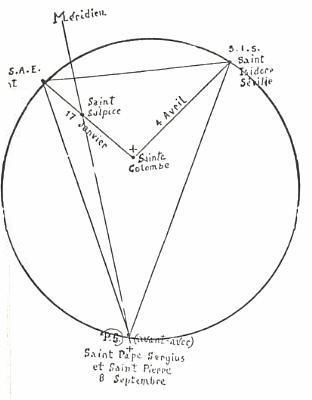
The appearance of two typewritten documents providing diagrams of the Coume-Sourde “Stone” entitled ‘The Cros Report’ (because it was ascribed to Ernest Cros, 1852-1946, provenance of which is unknown), sometime between 1962-1972. One version of the document coming from the typewriter of Noël Corbu bearing the letterhead of the Hotel de La Tour, the other in the possession of René Chésa.
The ‘Cros Report’ quotes directly from Paul Courrent’s Notice Historique sur les Bains de Rennes (1934): “Marie de Negri d'Ablès, Dame de Blanchefort, Seigneuresse of the Parish of Rennes-le-Château, died in Rennes-le-Château on the 17th day of January 1781, at the age of 61. (Registers of Rennes-le-Château – Archives of the Prefecture of the Aude)”.
And contains a reworked text of a paragraph from Courrent’s work: “The fiefs of Montferrand, of the Community of Les Bains and of the Castle of Blanchefort belonged in the 18th century to Messire François d'HAUTPOUL, Marquis de Blanchefort. The thermal springs of the Community of Les Bains passed into the ownership of Messire Joseph d'Hautpoul, knight, Marquis d'Hautpoul, who on 26 September 1752 married his cousin, the noble Marie d'Hautpoul-Blanchefort, as is apparent from the act of marriage, a copy of which follows, and which Monsieur POUX, the archivist of the Aude, has kindly extracted from the Parish Register of the Community of Rennes-le-Château”
1967
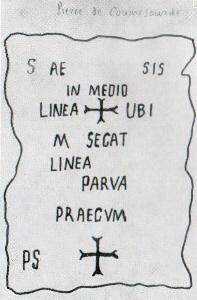
The version of the Coume Sourde “stone” published in Gérard de Sède’s 1967 book L’Or de Rennes, a re-written unpublished manuscript by Pierre Plantard
1967
The Cholet Report dated 25 April 1967
1970
Formerly
http://www.pays-de-couiza.com/renchato/renchato.html
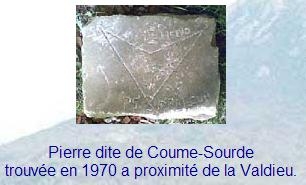
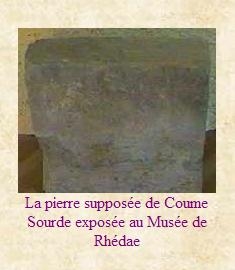
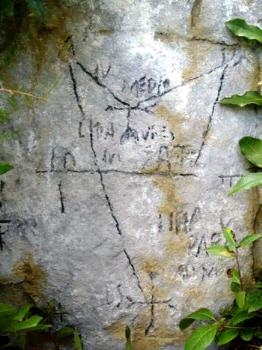
‘Pierre dite de Coume-Sourde trouvée en 1970 a proximité de la Valdieu’
1971-1973
Philippe de Chérisey, Pierre et Papier: “That Mr Cros existed is one thing, that the small wad of typed pages was from a typewriter that he would have used himself, is another. As far as I know, as I held these pages in my hands, they could equally be my work, which I could have passed to Mr Noël Corbu in Rennes-le-Château in exactly the same manner that I forwarded Documents I and II to Gérard de Sède”.
1972
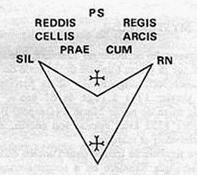
Robert Charroux, Trésors du monde enterrés, emmurés, engloutis (revised and reprinted edition of 1962 book, Fayard 1972)
1979
Jean-Luc Chaumeil, Le Trésor du Triangle d’Or (Editions Alain Lefeuvre, 1979)
1990
Letter dated 10 August by Pierre Plantard to Raymond Sagarzazu, stating “You refer to the tombstone of Coumesourde. I'm sorry to have to disappoint you, but it simply never existed”

2005
Formerly
http://www.rennes-le-chateau-archive.com/la_pierre_coume_sourde.htm
2007
2016
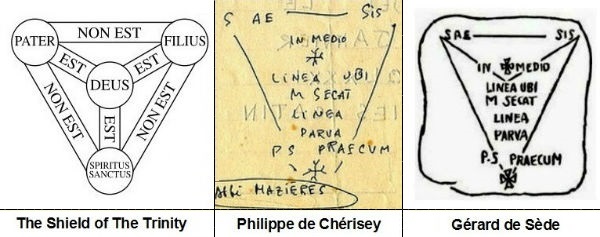
Philippe de Chérisey, creator of the popular version of the Coume Sourde “Stone”, modelled it on
The Shield of Trinity
|