The Sober Facts About The Monogram of
Frederick III Habsburg
Not Part Of A Black Magic Ritual
13 February 2026
Revised 14 February 2026
Assuming this is not some sort of Joke (extremely difficult to be able to tell the difference between a Joke and Research in this subject matter); there seems to be a current Madcap attempt to try and link Frederick III Habsburg and Bérenger Sauniêre into a Black Magic Ritual by Eugène Vintras, described in a book by Jules Bois.
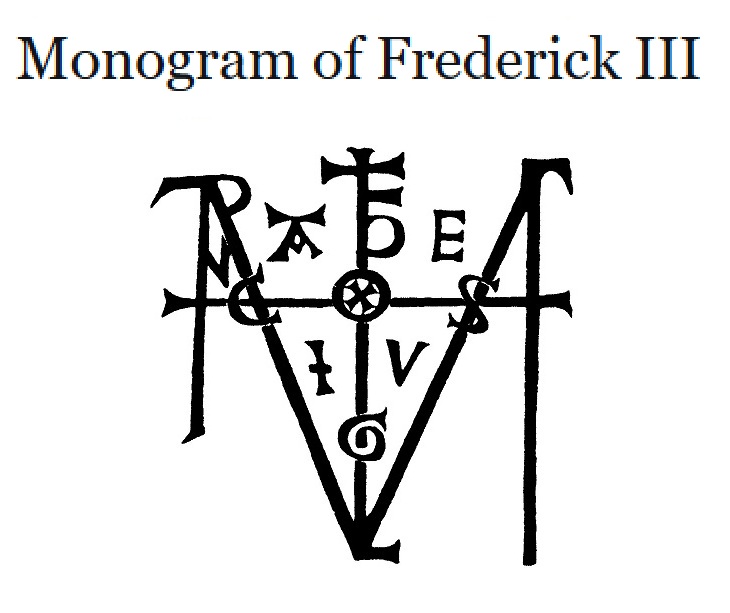
Frederick III Habsburg (1415-1493) became Frederick V, archduke of Austria in 1424. He acceded as Frederick III, Holy Roman Emperor in 1440 and was married to Eleanore of Portugal. Frederick III was the first member of the House of Habsburg to become Holy Roman Emperor. The Ruler's Signum manus, or Monogram, contained the letters of his motto, “aeiou”.
A.E.I.O.U. is usually interpreted as the Latin phrase Austriae est imperare orbi universo (“It Is Austria's Destiny To Rule The Whole World”). A German version is Alles Erdreich ist Oesterreich untertan (“All The World Is Subject To Austria”).
* The letters A. E. I. O. U. are the vowels of the English alphabet, fundamental for learning to read and pronounce words.
* A.E.I.O.U. can also stand for AEIOU, originally standing for Autism Early Intervention Outcomes Unit.
The idea that it “doesn't matter” if the “coume-sourde” stone is real or not is a cheap comment, since its only too obvious that Frederick III Habsburg did not have anything to do with a fake mystery that did not exist before the mid-1950s and which is deemed to be a mere Conspiracy Theory by the French Ministry of Culture.
The idea that the Monogram of Frederick III Habsburg and the “coume-sourde” Stone look vaguely similar to illustrations found in a book published in 1895 by Jules Bois is just ludicrous. It's just too stupid to laugh at.
Eugène Vintras was not a part of the Gnostic Catholic Church (Église Gnostique Catholique), as that organization was founded in 1907-1908, decades after his death in 1875. Vintras is often credited as one of the first in the 19th-century French occult revival to use an inverted cross, symbolizing a new “reign of the Holy Spirit,” which later became associated with modern Gnostic and occult imagery. While Vintras is considered a “Gnostic revivalist” in the broader sense of 19th-century French occultism, he operated entirely independent of the formal Gnostic churches that emerged in the 1890s and 1900s.
Frederick III Habsburg was the last Holy Roman Emperor to be crowned in Rome by the Pope (in 1452), a significant, deeply traditional act of Catholic loyalty. Frederick III travelled to the Holy Land in 1437, indicating a strong commitment to his faith. His tomb, located in St Stephens Cathedral in Vienna, was commissioned to feature saints and clerics praying for his soul. His reign established the Habsburgs as bulwark for “Latin Christendom” against the Ottoman Empire.
Also, Believers seriously think that there is a similarity between Saunière’s Gothic Folly – the Tour Magdala – and the Houyet Tower in Belgium – better called the Leopold Tower (Royal Château of Ardenne): A Neo-Gothic folly built by King Leopold I (that some believe was modelled upon a tower in Windsor Park), now a landmark for a nearby golf course, following the destruction of the main castle in 1968.
Again, Believers base their interpretation of the “coume-sourde” stone on a drawing found in a book by Jules Bois, “Le Satanisme et la Magie” (preface by Joris-Karl Huysmans, Paris, Léon Chailley, Éditeur, 1895). The book is available on the Gallica website, as well as on the archive.org website.
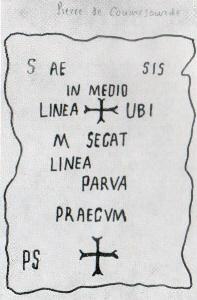
Here, however, is the first artistic impression of the “coume-sourde” stone, from an article by Robert Charroux found in “Plaisir de France”, Number 298, 1963 – before it getting rebooted by Philippe de Chérisey. So that theory gets blown up.
Perpetuating Tourism To Rennes-le-Château
Despite the deaths of some of the main protagonists of the Rennes-le-Château myth – Pierre Plantard in 2000, Gérard de Sède in 2004 and Henry Lincoln in 2022 – the mythmaking still goes on, albeit in a drastically less encouraging manner – because succeeding authors lack the necessary skill in writing – as well as failing to capture their readers attention.
It's as easy to debunk this generation's mythmakers as all previous generations – all that readers and researchers need to do is to cross-check their claims with the verifiable historical facts – but this is not so easy to do with the esoterics – who are only too likely to become willing disciples and will therefore fail at the first hurdle of their responsibilities.
We all know The Believers Motto: “We don't care about the facts, we want to believe”.
This is precisely what it takes to pin the Black Mass on Frederick III Habsburg and Bérenger Sauniêre!
It also makes for a good deterrent against all things relating to all the myths about Rennes-le-Château!
|