References to the Resurrection
older than
The Gospels
12 July 2003
Expanded 23 January 2026
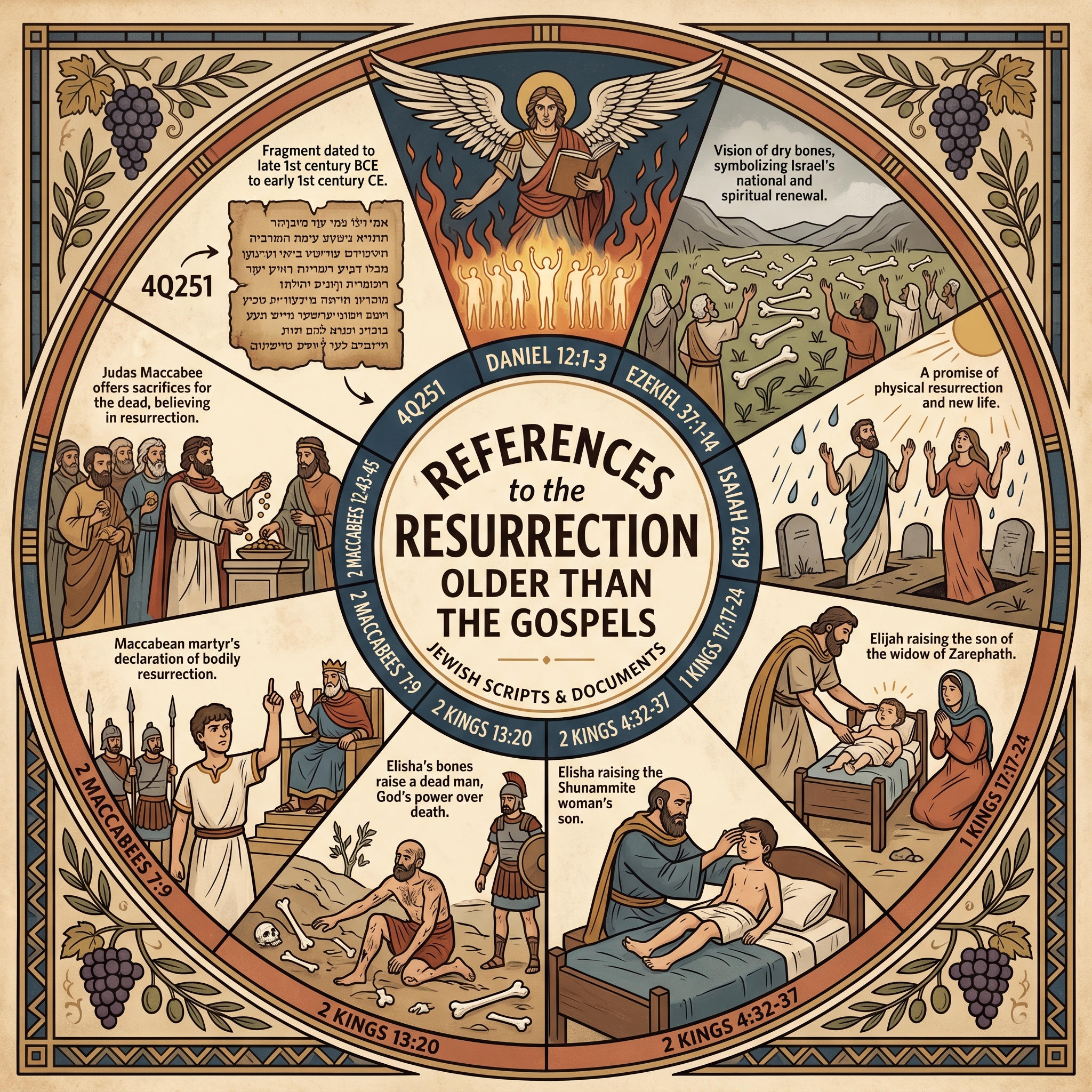
Daniel 12:1-3
“At that time shall arise Michael, the great prince who has charge of your people. And there shall be a time of trouble, such as never has been since there was a nation till that time; but at that time your people shall be delivered, every one whose name shall be found written in the book. And many of those who sleep in the dust of the earth shall awake, some to everlasting life, and some to shame and everlasting contempt. And those who are wise shall shine like the brightness of the firmament; and those who turn many to righteousness, like the stars for ever and ever.”
* Description of a future time of intense tribulation and distress for God's people, marked by the intervention of the archangel Michael, deliverance for those whose names are in “the book”, and the resurrection of the dead with some rising to everlasting life and others to eternal contempt, while the wise shine like stars. It's a key passage about end-times prophecy, the resurrection, and the reward for faithfulness.
Ezekiel 37:1-14
“The hand of the LORD was upon me, and he brought me out by the Spirit of the LORD, and set me down in the midst of the valley; it was full of bones. And he led me round among them; and behold, there were very many upon the valley; and lo, they were very dry. And he said to me, ‘Son of man, can these bones live? ’ And I answered, ‘O Lord GOD, thou knowest.’ Again he said to me, ‘Prophesy to these bones, and say to them, O dry bones, hear the word of the LORD. Thus says the Lord GOD to these bones: Behold, I will cause breath to enter you, and you shall live. And I will lay sinews upon you, and will cause flesh to come upon you, and cover you with skin, and put breath in you, and you shall live; and you shall know that I am the LORD.’ So I prophesied as I was commanded; and as I prophesied, there was a noise, and behold, a rattling; and the bones came together, bone to its bone. And as I looked, there were sinews on them, and flesh had come upon them, and skin had covered them; but there was no breath in them. Then he said to me, ‘Prophesy to the breath, prophesy, son of man, and say to the breath, Thus says the Lord GOD: Come from the four winds, O breath, and breathe upon these slain, that they may live. ’ So I prophesied as he commanded me, and the breath came into them, and they lived, and stood upon their feet, an exceedingly great host. Then he said to me, ‘Son of man, these bones are the whole house of Israel. Behold, they say, ‘Our bones are dried up, and our hope is lost; we are clean cut off’.
Therefore prophesy, and say to them, Thus says the Lord GOD: Behold, I will open your graves, and raise you from your graves, O my people; and I will bring you home into the land of Israel. And you shall know that I am the LORD, when I open your graves, and raise you from your graves, O my people. And I will put my Spirit within you, and you shall live, and I will place you in your own land; then you shall know that I, the LORD, have spoken, and I have done it, says the LORD.’
* God's vision to the prophet Ezekiel of a valley full of dry bones, symbolizing Israel's spiritual death and national despair during exile, and God's promise to bring them back to life, restore their nation, and fill them with His Spirit, creating a vast, living army. The passage shows God's power to bring hope and new life from utter desolation, ultimately restoring Israel to their land and creating a new covenant relationship with them, representing a spiritual resurrection and national renewal.
Isaiah 26:19
“Thy dead shall live, their bodies shall rise. O dwellers in the dust, awake and sing for joy! For thy dew is a dew of light, and on the land of the shades thou wilt let it fall”
* Describes a powerful promise of physical resurrection and new life from God, contrasting with the finality of death often seen in the Old Testament, offering hope for believers that their dead will live, rise, and sing for joy as the earth gives them up, much like refreshing dew brings life
1 Kings 17:17-24
“After this the son of the woman, the mistress of the house, became ill; and his illness was so severe that there was no breath left in him. And she said to Elijah, ‘What have you against me, O man of God? You have come to me to bring my sin to remembrance, and to cause the death of my son!’ And he said to her, ‘Give me your son.’ And he took him from her bosom, and carried him up into the upper chamber, where he lodged, and laid him upon his own bed. And he cried to the LORD, ‘O LORD my God, hast thou brought calamity even upon the widow with whom I sojourn, by slaying her son?’ Then he stretched himself upon the child three times, and cried to the LORD, ‘O LORD my God, let this child's soul come into him again.’ And the LORD hearkened to the voice of Elijah; and the soul of the child came into him again, and he revived. And Elijah took the child, and brought him down from the upper chamber into the house, and delivered him to his mother; and Elijah said, ‘See, your son lives.’ And the woman said to Elijah, ‘Now I know that you are a man of God, and that the word of the LORD in your mouth is truth’.”
* Describes the prophet Elijah raising the dead son of the widow of Zarephath, a miracle that validates Elijah as God's messenger and confirms God's word is true, leading the widow to acknowledge God's power and the truth of His prophet. After the boy dies, the distraught widow blames Elijah, but Elijah takes the boy, prays earnestly to God, and God answers by returning the boy's life, after which Elijah returns him to his mother, alive.
2 Kings 4:32-37
“When Elisha came into the house, he saw the child lying dead on his bed. So he went in and shut the door upon the two of them, and prayed to the LORD. Then he went up and lay upon the child, putting his mouth upon his mouth, his eyes upon his eyes, and his hands upon his hands; and as he stretched himself upon him, the flesh of the child became warm. Then he got up again, and walked once to and fro in the house, and went up, and stretched himself upon him; the child sneezed seven times, and the child opened his eyes. Then he summoned Gehazi and said, ‘Call this Shunammite.’ So he called her. And when she came to him, he said, ‘Take up your son.’ She came and fell at his feet, bowing to the ground; then she took up her son and went out.”
* Describes the miraculous raising of the Shunammite woman's son from the dead by the prophet Elisha. It is a narrative about God's power, the importance of faith, and Elisha’s compassion, as he brings life back to a child who had previously been promised to the barren woman.
2 Kings 13:20
“So Elisha died, and they buried him. Now bands of Moabites used to invade the land in the spring of the year. And as a man was being buried, lo, a marauding band was seen and the man was cast into the grave of Elisha; and as soon as the man touched the bones of Elisha, he revived, and stood on his feet.”
* Describes the end of the prophet Elisha's life, a miracle where a dead man is raised by touching Elisha's bones, the oppression of Israel by Syria under King Hazael, and the eventual recovery of lands by King Jehoash of Israel, highlighting God's faithfulness to His covenant despite Israel's sins.
2 Maccabees 7:9
“Thou cursed miscreant! Thou dost dispatch us from this life, but the King of the world shall rise us up, who have died for his laws, and revive us to life everlasting.”
* Describes one of the seven martyred brothers defiantly telling the tyrant Antiochus IV Epiphanes that even though the king is killing him, the “King of the universe” will raise him up to an “everlasting renewal of life” for dying for God's laws, showcasing strong Jewish belief in bodily resurrection and divine justice.
2 Maccabees 12:43-45
“He then collected from them, man by man, the sum of 2,000 drachmas of silver, which he forwarded to Jerusalem for a sin-offering. In this he acted quite rightly and properly, bearing in mind the resurrection – for if he had not expected the fallen to rise again, it would have been superfluous and silly to pray for the dead – and having regard to the splendour of the gracious reward which is reserved for those who have fallen asleep in godliness – a holy and Pious consideration!”
* Describes Judas Maccabee collecting money to send to Jerusalem for a sin offering for the dead, because he believed in the resurrection and that prayers and sacrifices could help the deceased be freed from sin and attain a better afterlife,
4Q251 (Dead Sea Scroll Fragment)
“And the Lord will accomplish glorious things which have never been as [He...] For He will heal the wounded, and revive the dead and bring good news to the poor...He will lead the uprooted and knowledge.”
* This fragment is generally dated to the late 1st century BCE to early 1st century CE.
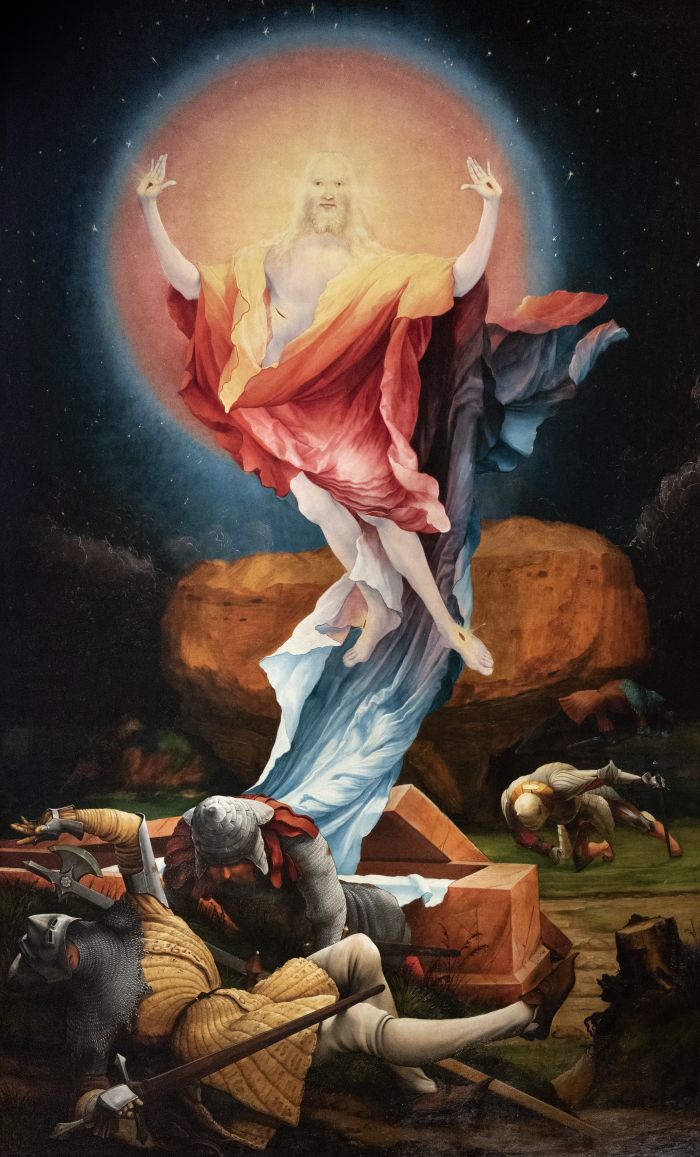
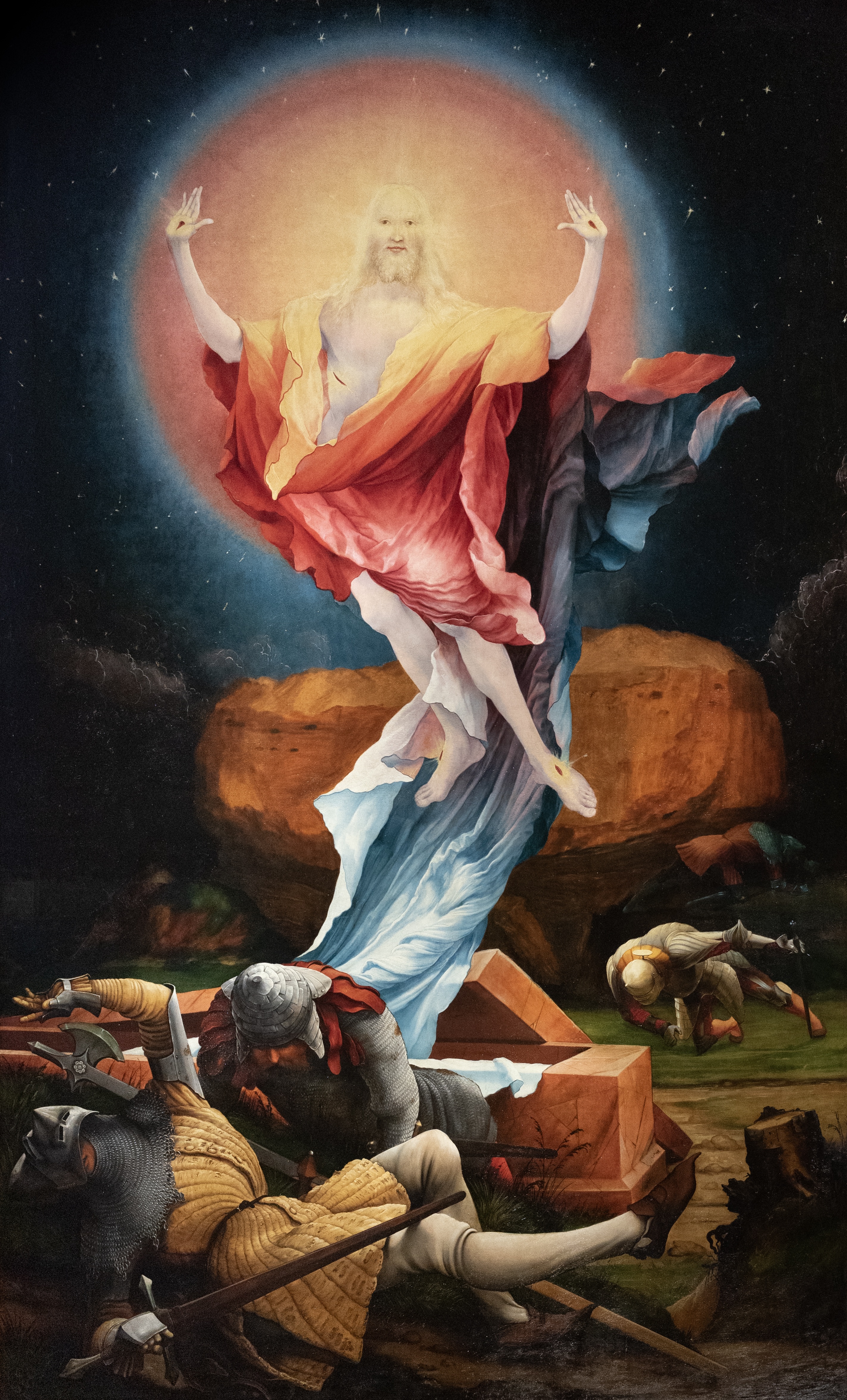
The Resurrection
Isenheim Altarpiece, 1515
Matthias Grünewald,
c1470 – 31 August 1528
|