Judaism, Ezekiel & Christianity
With AI Analysis
23 April 2026
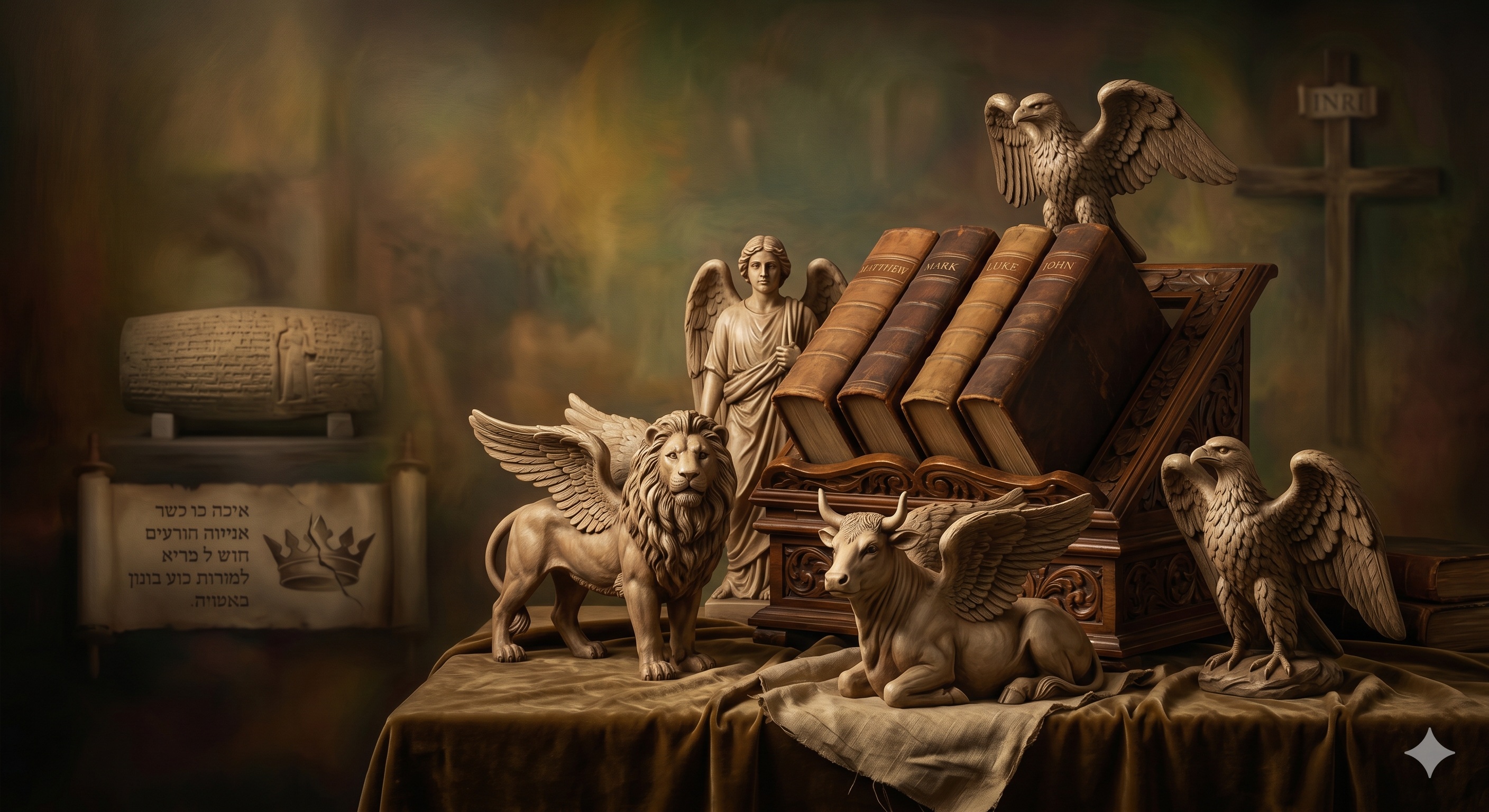
The Book of Ezekiel is firmly entrenched as being the starting point of Christianity, along with the Books of Daniel and I Enoch. The four creatures as described in the opening chapter of Ezekiel occupying the Throne-Chariot – having the face of a man, a face of a lion, a face of a bull, and a face of an eagle – just happened to correspond with the four Christian evangelists of Matthew, Mark, Luke and John.
In the Book of Ezekiel Chapter 37:15-17 is found:
15 The word of the Lord came to me: 16 “Son of man, take a stick of wood and write on it, ‘Belonging to Judah and the Israelites associated with him.’ Then take another stick of wood, and write on it, ‘Belonging to Joseph (that is, to Ephraim) and all the Israelites associated with him.’ 17 Join them together into one stick so that they will become one in your hand.”
Ezekiel 37:15-17 depicts a symbolic act where the prophet unites two sticks – representing the divided kingdoms of Judah and Joseph (Ephraim) – into one, symbolizing God's promise to reunite the fractured nation of Israel after their exile. This prophecy signifies the end of division, the restoration of the Davidic kingdom, and spiritual renewal.
The Book of Ezekiel continues:
18 “When your people ask you, ‘Won’t you tell us what you mean by this?’ 19 say to them, ‘This is what the Sovereign Lord says: I am going to take the stick of Joseph – which is in Ephraim’s hand – and of the Israelite tribes associated with him, and join it to Judah’s stick. I will make them into a single stick of wood, and they will become one in my hand.’ 20 Hold before their eyes the sticks you have written on 21 and say to them, ‘This is what the Sovereign Lord says: I will take the Israelites out of the nations where they have gone. I will gather them from all around and bring them back into their own land. 22 I will make them one nation in the land, on the mountains of Israel. There will be one king over all of them and they will never again be two nations or be divided into two kingdoms. 23 They will no longer defile themselves with their idols and vile images or with any of their offenses, for I will save them from all their sinful backsliding, and I will cleanse them. They will be my people, and I will be their God. 24 “‘My servant David will be king over them, and they will all have one shepherd. They will follow my laws and be careful to keep my decrees. 25 They will live in the land I gave to my servant Jacob, the land where your ancestors lived. They and their children and their children’s children will live there forever, and David my servant will be their prince forever.”
However, the Jewish Kingship was not restored when the Jewish People were released from their Babylonian captivity in 538 BCE. Christianity was – centuries later – forced to introduce an imaginary genealogy dating from this time that resulted in the birth of its Messiah, Jesus Christ.
Whereas Judaism relied on practical and operational warfare in its resistance against Roman Occupation, Christianity itself believed in the Divine Apocalypse, that would suddenly beam down from Heaven and restore Judea to its former glory that existed before the capture of Jerusalem in 586 BCE.
However, the historical context that was outside of everybody’s hands had changed and Christianity itself was forced to adapt, change, evolve and develop into something else in order to survive and to exist. Whether this is something that Mainstream Historians have not addressed due to their Historical and Christian dogma – or it is something that has genuinely been missed by Mainstream Historians is anyone’s guess. But it sufficiently explains the momentous difference between the Christianity of the First Century in contrast to the Christianity of the Second Century.
This article was written in part by the assistance of the conclusions of German 19th century Protestant scepticism of Christianity. Here is an AI assessment.
|