How Christianity Initially Developed And What It Knew
26 May 2026
REVISED 27 May 2026
The real solution to how Christianity began during the first few centuries of the Common Era is really easy to understand.
Originally, there were no “secrets” between Judaism and Christianity – only that they differed about the existence of the Coming Holocaust and the interpretation of the Garden of Eden myth in the Book of Genesis and the Forbidden Fruit. As it turned out, Christianity was only ever a minor and extremist Jewish Cult, nothing more. Christianity knew all about the workings of the Temple of Jerusalem and what the High Priest knew. There were no “secrets” between the two sects over this. Both Judaism and Christianity shared the same fundamental information over their respective rituals. But the division between them was brought about when Christianity failed to convince the majority of Judaism, and therefore it continued to remain an extreme minority Jewish Cult.
Several Jewish Wars occurred between the Jews and the Romans. In 66 CE, 67-68 CE, 70 CE and 73 CE. Then there was the rebellion sparked by Simon Bar Kokhba – The Bar Kokhba Revolt of 132–135 CE, which is also historically known as the Third Jewish-Roman War.
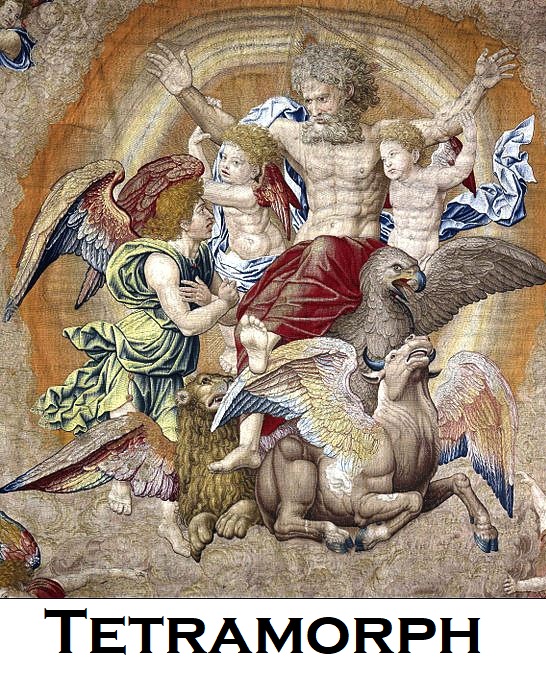
It was sometime during this latter period that the books known as the Gospels were invented holding the Vision of Ezekiel as its foremost symbolism. The four animals depicted in Ezekiel's Vision most probably represented the four consonants of the name of the Jewish God. As in many countries in the Near East, the Jewish God was cognate with the Jewish King. The Gospels were written in such a way so as to strongly advertise the story of Jesus Christ while simultaneously hiding the nature of the drug, built into its subtext.
Under Roman rule, Jerusalem was rebuilt and renamed “Aelia Capitolina” in 130 CE by Emperor Hadrian. “Aelia” was derived from Hadrian's nomen gentile (family name), Aelius. The name of “Capitolina” was dedicated to Jupiter Capitolinus, Rome's supreme deity, whose temple was built on the site of the destroyed Jewish Second Temple.
After the Bar Kokhba revolt in 135 CE, the Roman Emperor Hadrian banned Jews from entering or living in Jerusalem; the city was turned into a pagan colony, and the ban was strictly enforced under penalty of death. The official policy shifted slightly over the centuries, but the prohibition remained largely in place. The Christian Roman emperors continued the Hadrianic edict. Jews were still forbidden from taking up residence in the city, although archaeological evidence does seem to indicate that despite the official legal bans, some historians and archaeologists suggest that small numbers of Jews may have continued to reside in the area or sneak into the city, with some archaeological discoveries even hinting at a small
Jewish presence in the later centuries of the Byzantine period.
It was all out in the open about the psychedelic substances I suggest, including the knowledge being well known about to both the Greek and Roman occupiers of Judea. This can be gathered from reading certain passages from certain texts that are deemed “apocryphal” in nature. During the first century CE it would definitely have been widely known about. The whole story of Pontius Pilate and the Trial of Jesus Christ is openly ridiculous and could not have been written during the First Century CE.
The Apocalypse was abandoned, the Jews were abandoned, and the death, crucifixion and resurrection of Jesus Christ served as a very poor substitute of The Apocalypse that never happened. The dating of the “Historical Jesus Christ” had to start from before when the Apostle Paul preached his ministry – Jesus Christ had to exist prior to that period. The references to Jesus as “descended from David according to the flesh” (Romans 1:3) and “Remember Jesus Christ, raised from the dead, descended from David. This is my gospel” (2 Timothy 2:8), were only metaphors in the same way that Ezekiel's Vision (of a bull, eagle, lion and a man) was viewed and adopted by the Christians in a purely symbolic way (called the “Tetramorph”).
There must have been many casualties during the period of the Wars of the Jews against Rome when they ultimately lost. There could not have been many witnesses who survived to tell the story that what's written in the Gospels was completely false (although there is one such account). It was this fact and environment that brought about the “Historical Jesus Christ” virtually without any contradictions. The Jews became a Race without a Country and became scattered around the world. It was free and easy to invent the story of “Historical Jesus Christ, a Son of God, a veritable miracle-worker who healed the sick, raised the dead, and demonstrated God's power by Rising from the Dead”. It was a safe bet that there wouldn't be many people who gave contradictions to the contrary. This is what actually happened.
The Roman Empire embraced the Gospels, Christianity became the State Religion of Rome and The Vatican was based in Rome. The Gospels became a very poor substitute for The Apocalypse-That-Never-Happened during the First Century CE. Christianity was victorious in both its opposition to Judaism – as well as becoming the State Religion of Rome.
The Gospels are a shadow of what Christianity originally was.

|