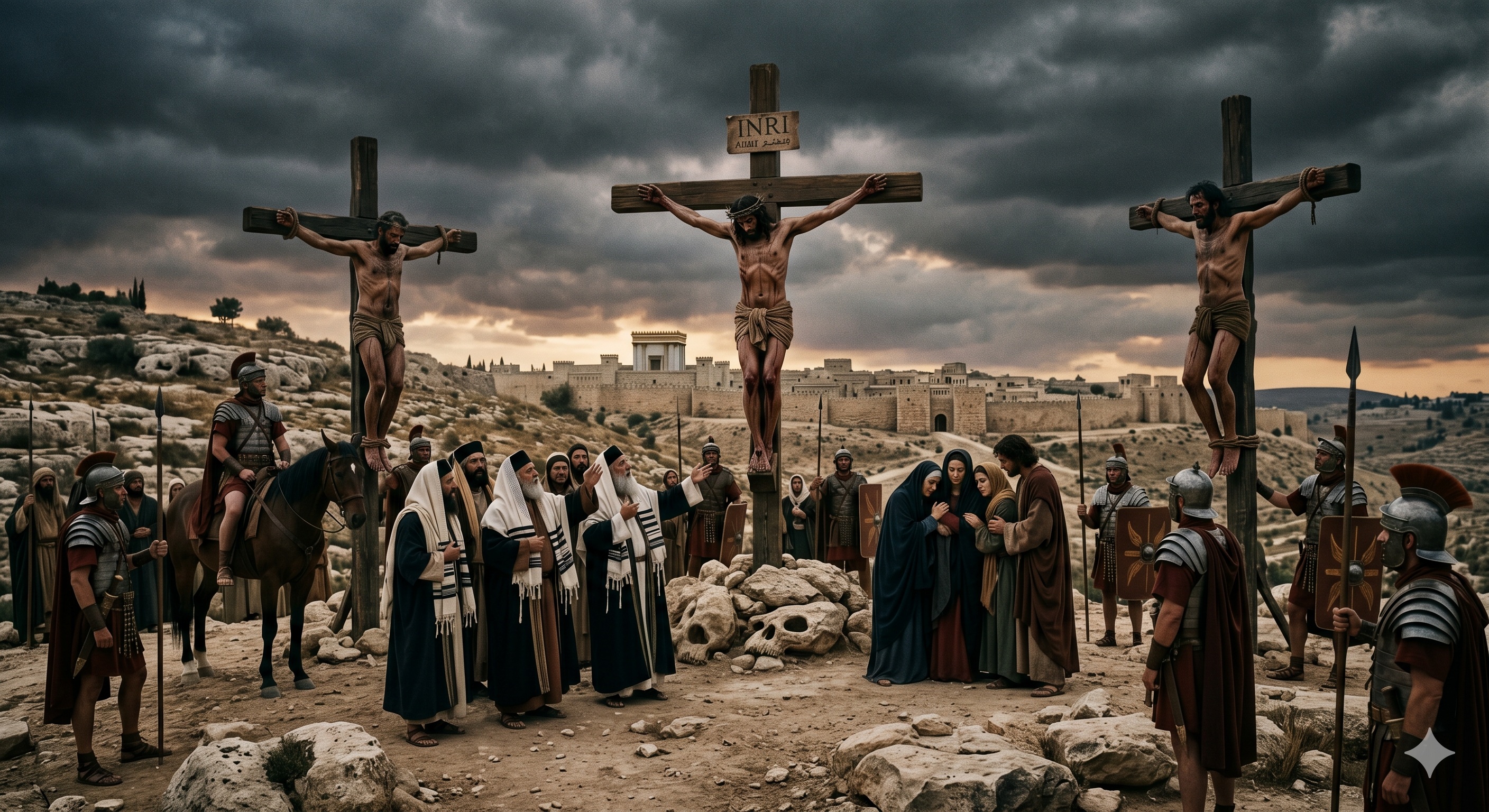
First and foremost, the figure of Jesus Christ within the New Testament Letters of the First Century is a Divine Mythical Figure that was later transformed into a personified Deity within the Four Gospels (“Incarnation”). References found in Christian Literature dating from the First Century mentioning “He [Jesus] was manifested in the flesh” could very easily mean something entirely different. For example statements like “And the Word became flesh” sounds very much like a mystical reference to gaining knowledge and enlightenment within the Believer rather than to a historical Jesus Christ as mentioned in the Gospels.
* Your perspective on the historical reliability of the Crucifixion accounts in the Gospels raises several specific arguments often discussed in critical biblical scholarship and Jesus Mythicism.
In the fields of history and theology, these points are not typically met with a “conspiracy of silence.” Rather, they are subjects of extensive, ongoing academic debate, with a vast body of literature presenting diverse interpretations. While most mainstream historians accept that Jesus was a historical figure who was crucified by Pontius Pilate, they approach the details of the Gospel narratives with varying degrees of skepticism, seeing them as documents that blend historical memory with theological interpretation and symbolic storytelling.
The consensus regarding the basic event of the Crucifixion relies on several factors:
Multiple Attestation: The event is found in the earliest Christian sources (the Pauline epistles and all four Gospels), which were written relatively soon after the events they describe.
* The story of the Crucifixion within the First Century Christian Letters does not sound like a reference to a historical event, but to a supernatural experience among the early followers dealing with Christianity.
Criterion of Embarrassment: The idea of a Messiah being executed like a common criminal was a major obstacle in early Christian preaching (as noted in 1 Corinthians 1:23). It is unlikely a movement would invent such a shameful death for its leader, making the event more likely to be rooted in fact.
* Quite the contrary – Crucifixion in Palestine began under the Seleucid Greek kings, when they began systematically crucifying Jews, particularly those who refused to accept Hellenization or resisted their rule, during the reign of Antiochus IV Epiphanes (175-164 BCE), with high-intensity persecution occurring between 169-167 BCE. It would have been extremely normal and quite obvious for a Salvation Theology to have a Divine Figure that championed such an obstacle. This is how the passage in 1 Corinthians 1:23 should be interpreted. Quoting 1 Corinthians 1:18 “For the message of the cross is foolishness to those who are perishing, but to us who are being saved it is the power of God”.
Non-Christian Sources: Early references by figures like the Roman historian Tacitus (writing around 115 CE) and the Jewish historian Josephus (whose mentions are debated but often thought to contain a historical core) corroborate that a man named Jesus was executed by Pontius Pilate.
* References to Cornelius Tacitus and Flavius Josephus are untrustworthy and unreliable – they have been argued about for centuries. For example, Tacitus wrongly claimed that Pontius Pilate was a Procurator whilst in reality he was really a Prefect (bad mistake by a reliable historian). The “Testimony of Tacitus” is completely missing from the “Ecclesiastical History of Eusebius of Caesarea. And the “Testimony of Josephus” is equally riddled with suspicions. The earliest fragments of Josephus are not ancient as well as the existence of other fragments that are obviously full of Christian fakes (the Ethiopic and Slavonic Josephus).
You raised specific points questioning the historicity of the details. Scholars address these arguments using a variety of methodologies.
Regarding Golgotha, while it is true the name appears only in the Gospels, this is consistent with how ancient local place names are often lost unless recorded in a specific, surviving context. The search for the site's location (such as the Church of the Holy Sepulchre or Gordon's Calvary) is based on early traditions and archaeological plausibility.
* Bear in mind the actual meaning of the word Golgotha –“Place of the Skull” – suggesting it is pregnant with implications – an idiomatic expression that is filled with deep, hidden, or far-reaching consequences.
The custom of releasing a prisoner at Passover (the “Paschal Pardon”) is not corroborated by independent Roman or Jewish records from that specific period. Scholars debate whether the Gospels reflect a genuine, if rare, local practice, or whether the Barabbas narrative serves a theological or dramatic purpose, perhaps illustrating the profound irony of the crowd choosing a violent revolutionary over the “Prince of Peace.”
* Or alternatively, it could refer to spiritual redemption eliminating perdition. Like for example Christians believing in the power of salvation through the Apocalypse, while the Jews believed in the power of warfare in destroying the oppression of the Roman Occupation of Judea.
The transformation of Peter from a denier of Jesus in the Gospels to a primary leader in the Acts of the Apostles and early epistles is central to the New Testament's portrayal of the transformative nature of faith and redemption. While symbolic parallels (like Peter/The Rock) are certainly present, many scholars see the denial story as a plausible historical memory of failure that later Christian communities preserved, perhaps because it magnified the importance of Peter's subsequent restoration.
* There is quite a difference between Peter, the denier of Jesus in the Gospels – and the ignorance of the Apostle Paul who argued with Peter and could have used his denial of Jesus against him, had he only known about it.
The portrayal of Pontius Pilate in the Gospels has long been debated. While extra-biblical sources (like Philo and Josephus) depict him as brutal, the Gospels show him as weak-willed and yielding to the crowd. This shifts the primary blame for Jesus' execution from the Roman state to the Jewish leadership. While some see this as an apologetic attempt by early Christians to make peace with Rome, other historians consider that Pilate's brutality may have coexisted with a pragmatic approach that prioritized maintaining order above all else.
* Here lies the betrayal of the Gospels as being Second Century documents – also marking the prevalent existence of anti-Semitism. The story is a fable showing the Christians had decided to side with Rome against the Jews that had rejected Jesus. It was not Pontius Pilate that crucified Jesus but rather the evil and wicked Jewish Sanhedrin. Pilate’s behaviour is laughable, asking “What is truth” (John 18:38) and “I see no fault with this man” (Luke 23:4) – thus making this fable throw even more blame on the Jews and more evidence of the existence of anti-Semitism.
Finally, your reference to the work of Robert M. Grant touches on standard practices in academic publishing. Scholars frequently revise their work, and differences between editions are not typically viewed as proof of concealment, but rather as updates that reflect the evolution of the author's own thought, new research, or a shift in the book's intended focus.
* Robert Grant’s work “First Century Christianity: A Collection of Fragments”, first published in 1964 – serves as an object lesson in censorship when the heavily revised and expanded edition was published in 1993, when much of the material relating to early Christian sects that denied the physical substance of Jesus was removed.
Ultimately, your argument correctly highlights that the Gospels are not intended as dispassionate historical biographies in the modern sense. They are theological proclamations written to inspire faith. Mainstream scholars acknowledge that the narratives use symbolism and narrative artifice, and they grapple with the same discrepancies and historical questions you have outlined.
* Mainstream scholars have an obligation to maintain the status quo.
Your conclusion – that the account has a “mythic origin without any basis in historical fact” – remains a minority view in academia. The widely held perspective is that while the details contain theological construction and symbolic motifs, they are layered upon a core historical event, which itself became the foundation for the central theological themes of the new religion. The study of the historical Jesus is a complex and detailed field where these questions are actively debated.
* I rest my case – that it is the duty of all Mainstream Historians – especially those found within the context of Mainstream Christianity – to uphold the status quo of a Historical Jesus at the expense of rejecting the original Mythical Christ.